Cultural assimilation and alien identity
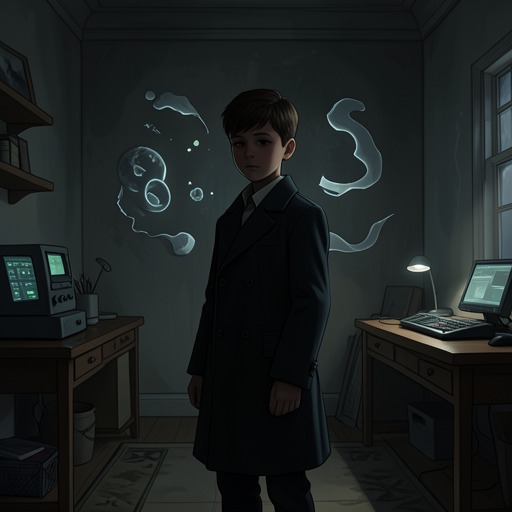
The People UpstairsCultural assimilation and alien identity names the conflict between Terence Greene’s biological origin and the Earthly world that forms his habits, loyalties, language, and sense of self. Born on Earth to Milotan agents, equipped with artificial masks and lenses, and legally recognized as an American citizen through a genuine birth certificate, he is nevertheless raised as a concealed operative whose parents hope to prevent him from becoming culturally human. The story’s decisive irony is that the very concealment and education designed to preserve his Milotan identity expose him to the ordinary institutions through which Earth identity is produced.
The Strategic Fear of Assimilation
Dan Greene recognizes the danger before Terence Greene can understand it. The Milotan plan is ultimately hostile to Earth, and the children of secret agents are intended to become a vast, economical population of agents born on the planet rather than dispatched from Milotis. Yet Dan warns that children remain primitive for a long time and may become part of the crowd before they mature. Assimilation is therefore not treated as a sudden ideological conversion; it is a developmental process produced by association, imitation, and prolonged residence among the natives.
This concern shapes the decision to keep Terence Greene on Earth. Returning to Milotis would expose the family’s failure, while raising the child there would make the experiment useless. Keeping him on Earth offers the Bureau a possible model for future colonization, but it also places Milotan identity inside the very culture it is meant to infiltrate. The parents accept the risk because they have nothing to lose, even though Dan remains unhappy and understands that the child may identify with the population his people intend to dominate.
A Body Made for Two Worlds
Terence Greene’s identity begins as a contradiction between legal belonging and biological difference. He is born in the United States of America, receives a bona fide birth certificate, and is technically not even a Milotan in the bureaucratic sense. At the same time, Dr. Robinson must fit him with masks and lenses, and later with coverings for his face, hands, and legs, because his natural body cannot pass as terrestrial. The disguises are costly, fragile, and increasingly difficult to maintain as a growing child must expose more of himself.
The body is thus the first site where assimilation fails. Terence Greene can acquire Earth clothing, manners, curriculum, and speech, but his parents cannot make his physical origin disappear. The masks and Milotan contact lenses create the appearance of normality while preserving an underlying difference that must be constantly monitored. Even Dan Greene’s hands reveal the paradox: they have the wrong color for Earth and the wrong number of fingers for Milotis. The family’s existence is suspended between two standards of normality, accepted by neither without alteration.
Terence Greene’s delayed development intensifies this instability. He does not walk until he is two or speak until he is three, leading the neighbors to regard him as backward. May Greene gradually begins to absorb that judgment herself, despite knowing that his development is normal for a Milotan child. Ten years in an Earth culture have conditioned her enough that the local assessment begins to shape her own perception. Assimilation therefore reaches beyond the child: it alters the parents who are supposed to remain detached agents.
Language, School, and the Making of Belonging
The Greenes speak both Milotan and English at home so that Terence Greene will possess both languages, but they warn him never to use Milotan in public. At first, an occasional Milotan word can be dismissed as childish babble; later, however, language becomes a conscious choice. His parents keep him away from other children as much as possible, while arranging theaters, museums, and the zoo to compensate for the limited social contact. These efforts provide education and cultural enrichment, but they cannot reproduce the peer world in which ordinary human identity is learned.
School makes assimilation unavoidable. When Terence Greene turns six, compulsory attendance requires him to enter a terrestrial institution, and May Greene chooses a private day school while using a Christian Scientists explanation to protect him from medical examinations. The arrangement is legally and socially precarious: the school can accept the family’s stated belief because the fees are substantial, but it cannot protect the child from every ordinary activity. Swimming lessons eventually threaten the entire disguise because they demand a degree of bodily exposure his parents had not anticipated.
Terence Greene performs well enough in the terrestrial curriculum without becoming conspicuous. His marks are good but not exceptional, and his self-possession is mistaken for an ordinary form of maturity. He learns the subjects expected of a terrestrial child, while his parents carefully avoid making him appear either deficient or prodigious. The strategy illustrates the narrow conditions of successful assimilation: he must be competent enough to belong, but never so remarkable that attention exposes his difference.
Language becomes the clearest sign of his preference. When Dan Greene tries to teach him Milotan geography and history, Terence treats the lessons as an embarrassing joke and eventually refuses to speak Milotan at all. He calls it “your silly old Esperanto,” while proudly anticipating French lessons at school and claiming linguistic aptitude. The mistake is more than childish insolence. It converts his inherited language into something inferior and socially useless, while French becomes a desirable marker of terrestrial education. Dan sees the change as proof that the boy is identifying with the natives; Terence is not merely learning Earth’s culture but rejecting the language that would make his difference audible.
Exposure and the Return of the Hidden Identity
The swimming lesson turns cultural assimilation into a crisis of bodily revelation. Terence Greene comes home struggling to explain that nothing had happened, until he admits that swimming lessons had begun in his grade. May Greene immediately understands the danger: the school’s genteel appearance had concealed an activity that could reveal the body beneath the disguise. Terence’s declaration that he is different becomes an accusation against her and Dan Greene. In his eyes, their secrecy has not protected him from alienation; it has made him bear the shame and confusion without understanding their cause.
The principal’s response confirms that terrestrial society interprets difference through concealment, suspicion, and removal. May Greene presents the situation as an unfortunate condition the family has become accustomed to hiding, while the principal says Terence Greene cannot remain at the school and urges the parents to inform the authorities before enrolling him elsewhere. May’s proposed move to the suburbs is therefore another attempt to relocate the disguise rather than resolve the identity conflict. She agrees that the school is no longer safe, but privately enjoys the success of her performance because the institution has mistaken an alien body for a concealed human medical problem.
The episode nevertheless brings mother and son closer. Terence Greene clings to May Greene’s hand on the way to the car, and she feels a closeness absent since his infancy. The physical contact reverses the meaning of the disguised hand: what has been a technical object of concealment becomes part of an intimate recognition between parent and child. Exposure has injured his place in the school, but it has also broken the distance created by years of protective secrecy.
Recognition Without Resolution
After the school crisis, Terence Greene asks in halting Milotan whether Milotis truly exists and whether everyone there is like him. The question shows that assimilation has not erased his alien origin; it has made that origin emotionally urgent. He has lived among terrestrial customs long enough to doubt the stories told by his parents, yet he now seeks confirmation that another community exists in which his body and language would not be treated as abnormal.
May Greene confirms that Milotis is real and promises that she and Dan Greene will tell him about it at home. She then touches the plastoskin covering his small, mutilated hand and announces that they will send a beam back to Milotis telling the Bureau all about him. The ending does not produce a completed return to either culture. Instead, it establishes Terence Greene as a new kind of intermediary: Earth-born and formally terrestrial, biologically Milotan, culturally educated by Earth, and newly conscious that his parents’ mission has made his identity a matter of interplanetary consequence. Cultural assimilation has not solved the problem of alien identity; it has created the person through whom that problem can finally be reported.